
I Built a Monster. The New Lucas Mesu Mount.
I purchased the New Mesu Mount a few months ago and thought I'd share my thoughts here, since there isn't much information available on it yet.
Why I went with Mesu
I was building an array with five scopes, including two 8" Edge HDs, so I needed something formidable. I looked at the SkyWatcher EQ8-R, but it didn't inspire confidence. The Trident by JTW looked great, but they were unresponsive to some follow-up questions I asked, and it was rather expensive once you factored in the required accessories, pier, and shipping costs.
I finally landed on the new mount from Lucas Mesu, as it had an impressive payload capacity of 100 kg at a modest price. Spending a lot of money on something unproven was a gamble, but so is my whole project. The industrial design and "rough" finish did make me a bit hesitant, but Mesu's previous mounts have been performing well in large observatories around the world, and Lucas believes this mount is even better than those — so I was in.
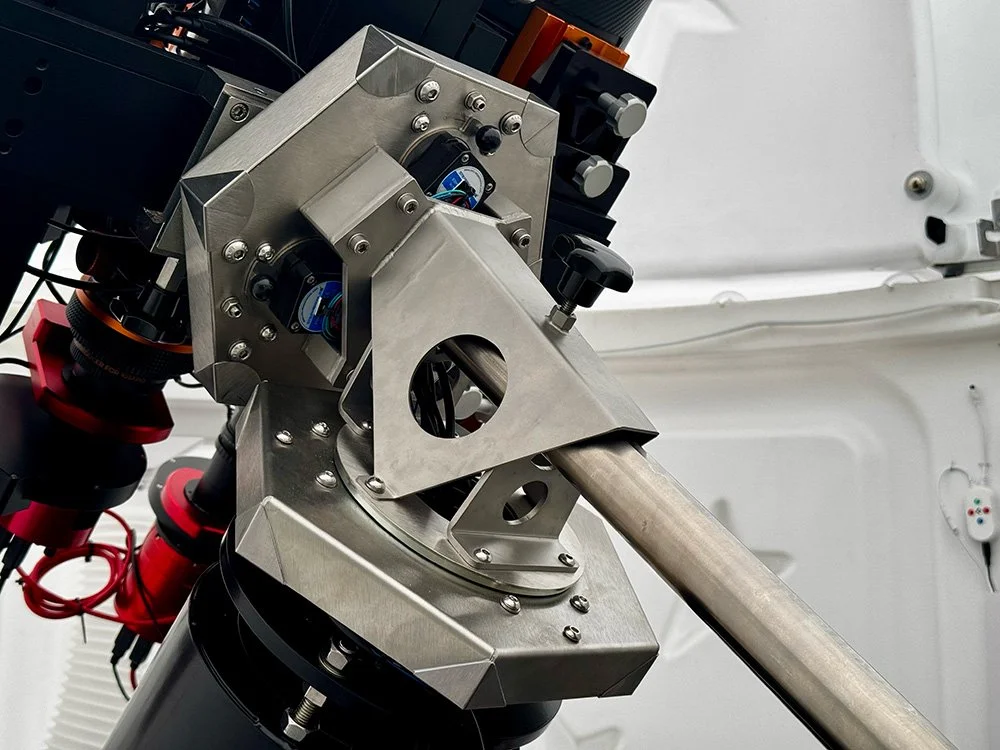
The New Mesu Mount.
Ordering and build quality
Lucas Mesu was very easy to deal with. Despite our time zone differences, we found a rhythm for emailing back and forth. I paid a deposit and was quoted six weeks for production, which turned out to be exactly correct.
I'll link to the mount page HERE, but in a nutshell, the New Mesu Mount is an EQ mount that uses a friction drive controlled by OnStep. The beauty of this is that there's no backlash and no grease or maintenance to deal with. It weighs about 18 kg but can move up to 100 kg thanks to 40 Nm of torque from its six stepper motors. Using OnStep and cheaper motors brings the mount's cost down significantly.
It's also a bent-knee (flipless) pier design that doesn't require meridian flips. The pier is custom-built to your latitude for polar alignment. I don't run mine flipless, though — my imaging train is long and perfectly balanced, so I'm not messing with it.
The mount and pier were very well packaged and arrived in great condition. Setup was straightforward — a few nuts and bolts and everything went together nicely. This mount is in a different league than my previous SkyWatcher and ZWO mounts, all of which I sold to fund this purchase.
I went with mounting hardware from ADM Accessories. Adam is great to deal with, and his products are top-notch in terms of build quality. I have three scopes in tandem and two piggybacked, so it took a lot of hardware to build out. Five telescopes and all the gear weigh a lot — I'm not sure exactly how much, but it's well over 100 lbs.
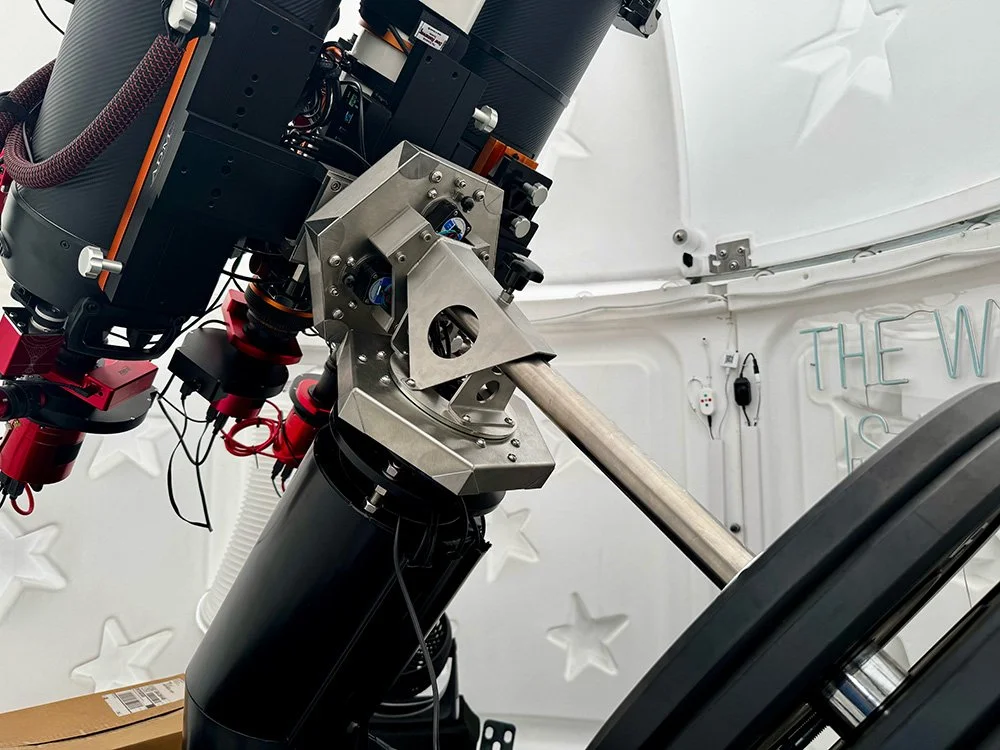
ADM triple saddle with over 100 lbs of payload onboard.
One of the great things about the Mesu mount is that it offers an adapter to use 2" gym weights instead of the much pricier astronomy-specific counterweights. I purchased two adapters and had Lucas modify them to make more space, since I'm running 90 lbs of counterweight on this setup. It's a monster.
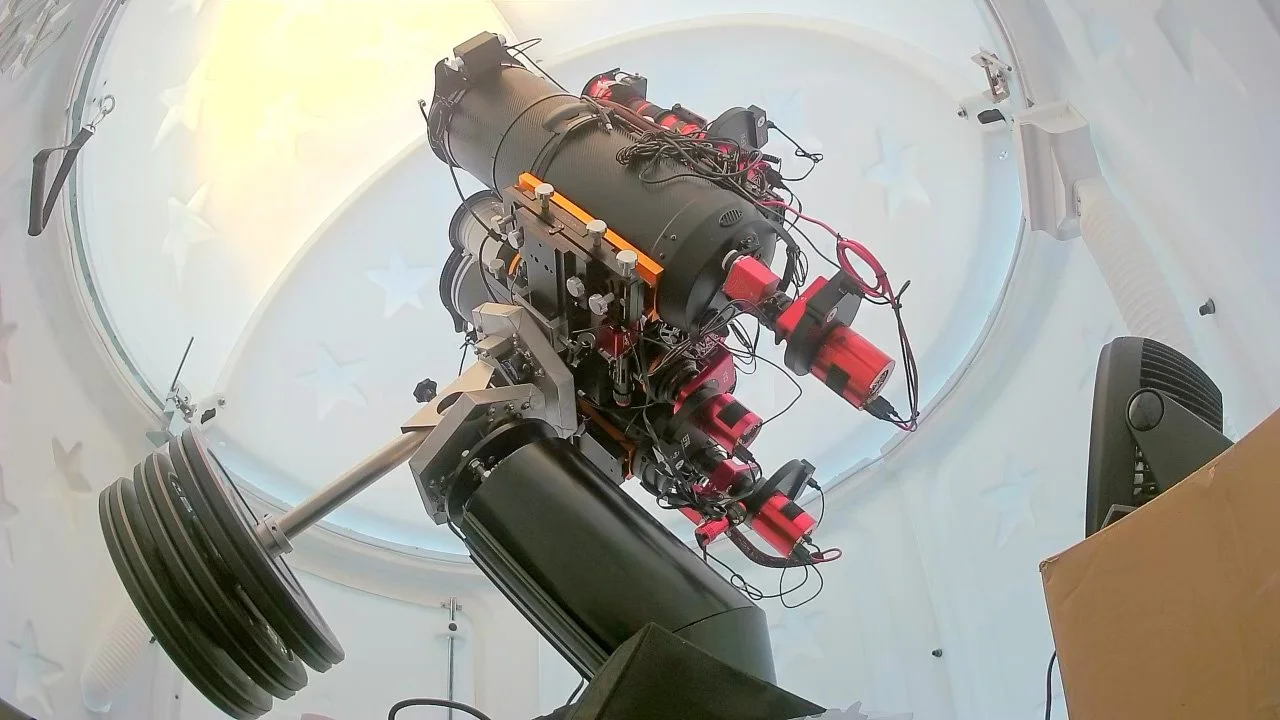
90 lbs of counterweight is no joke.
Software and setup
Using a mount that uses a 3D printer controller/motors with OnStep is nice because some of the parts and software are easy for the user to service. I accidentally fried a motor controller while testing and was able to order and install a replacement in under 24 hours for very little cost. It took a minute to get familiar with OnStep, but it's not overly complicated to use through its web interface.
Setting up the mount with NINA was annoying because of a conflict with longitude — it kept slewing in the wrong direction — but I eventually sorted that out, and it played nice after. My original plan was to run five separate instances of NINA on a PC in my observatory, and it worked for the most part. But I started getting driver conflicts from having five identical rotators, focusers, flat panels, etc. connected, which led me to miss several clear nights troubleshooting. I hate driver issues.
I've been a Mac user since I went to film school 25 years ago and don't have the patience to deal with Windows PCs and all their problems, so I ditched the PC and NINA and went back to ASIAIR. The only downside is that I can't synchronize dithering, but everything else is significantly easier. My first night with ASIAIR worked exactly as it was supposed to — seamlessly. My GoTos and guiding were great right away without messing with anything.
Guiding performance
Lucas claims the mount will guide in the 0.2" RMS ballpark, and he wasn't lying. My first couple of sessions were around 0.4" RMS, which is better than every previous mount I've used aside from PlaneWave. My third session guided at 0.25" all night with five telescopes and 90 lbs of gym counterweights — amazing.
The mount guides beautifully — perfect subs every time, except of course for the ones the secondary scopes take during dithering. I call that the dither tax. Long story short, the guiding performance is amazing. I'm sure with more tweaking, or different software with a sky model, I could push my RMS down further, but getting 0.25" RMS out of the box on an ASIAIR is a testament to Lucas' engineering. When I mentioned to Lucas that I was happy with the 0.4 RMS he seemed rather upset and wanted to see my guiding logs haha. He asked about my seeing conditions, and rightly so because they are atrocious. I am right between the ocean and the mountains in the middle of the Bortle 9 city, so seeing is absolutely the bottleneck for guiding here.
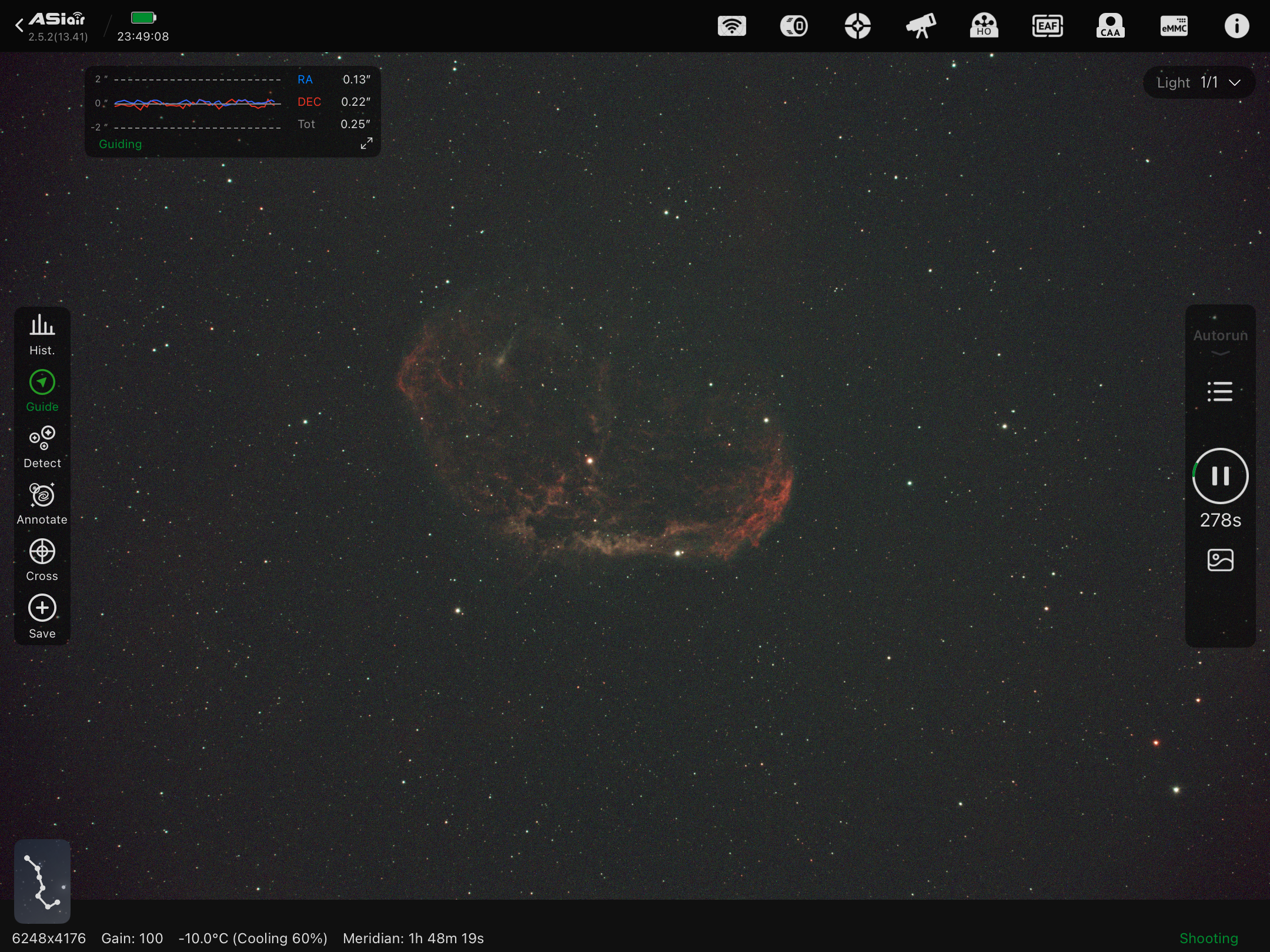
Look at that guiding RMS!
Final verdict
For the price versus performance, this mount is a tremendous value. It can move a lot of payload in an extremely accurate way, and at a very attractive price. I wasn't sure what to expect from such a new mount, especially with zero information or discussion about it online anywhere. My faith has paid off, and I'm extremely satisfied with this purchase — it's one of the best decisions I've made in my astronomy journey.
This mount lets me run five scopes on one mount in my observatory with a ton of automation to make my work a lot easier. I used to have five rigs on my roof under covers — this mount made my observatory make sense again, lol!
I can highly recommend Lucas' mount to anyone interested. It's incredibly solid and, in my opinion, a couple of steps above the nearest competition.
If you have any questions or comments, please leave me a note and I'll be happy to answer them to the best of my ability.
Clear skies! Rob